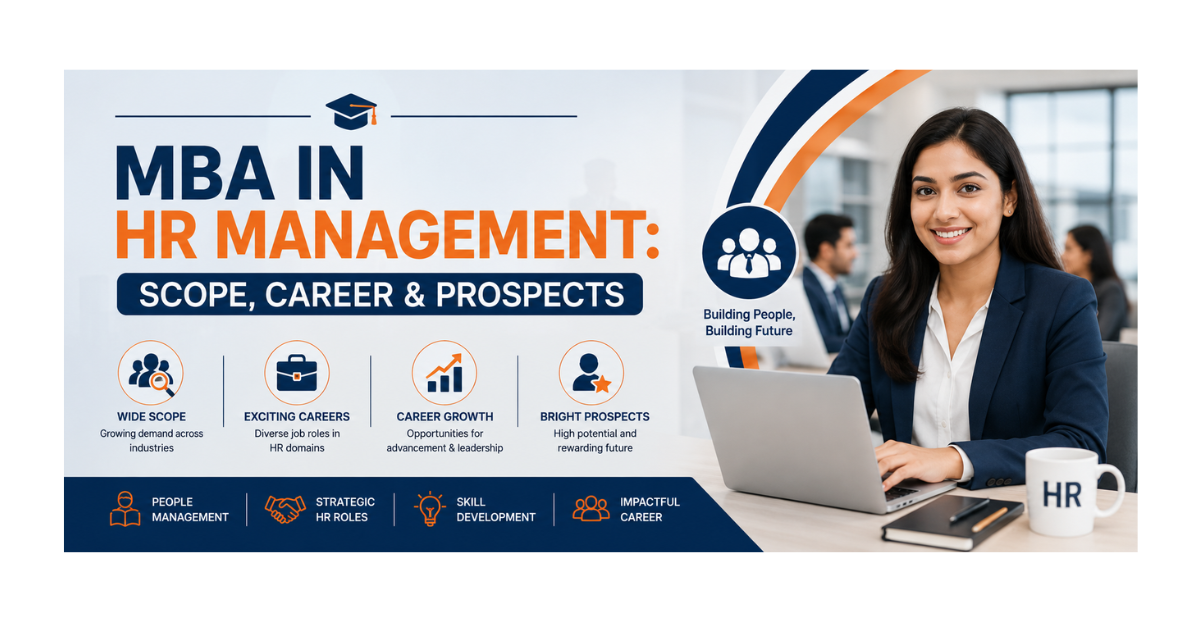
Picked HR yet? Or are you still stuck between that and finance, marketing, ops... the usual suspects everyone weighs during MBA counselling season. If people fascinate you more than balance sheets do, you're probably reading the right article.
I spoke to a few HR managers while putting this together, and honestly, the field looks nothing like what most college brochures describe. It's messier, more strategic, and a lot more interesting than "conducting interviews and managing leaves." Let's get into what this degree really involves and where it can take you.
Enquire Now
What Exactly Is an MBA in HR Management?
To put it simply, it consists of a two-year-long program educating you on how businesses recruit, develop, and retain talents. I wrote "hire people and process payroll," but that's not how it works in the real world. " That's the old, watered-down version of HR that stopped being accurate years ago.
Today's HR blends behavioral psychology, business strategy, and increasingly, data. An MBA in this specialization is meant to put you in rooms where actual business calls get made, not just handing you a stack of forms to file.
You'll cover recruitment, labor law, compensation structuring, organizational behavior, the whole spread. The value of the program lies in your acquiring the skills for linking human capital decisions to business outcomes. That's the distinction between a person who merely "does HR" and a person who's able to influence the way a company develops.
Why Companies Are Suddenly Obsessed With Good HR People
Back in the day when nobody took human resources seriously? That's no longer the case. Hybrid working conditions have become normal, employees can no longer be loyal to their companies just for the sake of it, and young employees expect meaningful work instead of only a monthly paycheck.
Try running a company today with an HR team that only schedules interviews. It won't hold up. Businesses need HR folks who can catch attrition risk before someone actually quits, who can build pay structures that don't wreck the budget, and who can shape a culture people don't want to escape from. That's basically the whole reason this degree carries so much weight now.
What You Actually Study in This Course
Core Subjects You Can't Skip
Doesn't matter if you're studying in Pune or in Manchester, most MBA HR programs cover roughly the same ground:
- Organizational Behavior
- Human Resource Planning
- Labor Laws and Industrial Relations
- Compensation and Benefits Management
- Talent Acquisition and Recruitment
- Performance Management Systems
- Training and Development
None of these are filler. They're the actual backbone of the course, and interview panels love testing candidates on at least two or three of them during placements.
The Electives That Make You Stand Out
This is honestly where you get to make smarter choices than the person sitting next to you. Depending on your institute, electives might include:
- HR Analytics (probably the fastest-growing area right now)
- Global HR Management
- Change Management
- Organizational Development
- Diversity, Equity, and Inclusion Strategy
Pick electives based on where the field is going, not where it's been. HR Analytics used to be a bonus skill. Now it's edging toward "expected," the same way Excel went from impressive to assumed over the last decade.
Who Should Even Consider This Degree
No one needs to be in HR if they don’t want to, and they can still succeed at other jobs. Think about whether or not you enjoy investigating human behavior and whether or not you can take part in awkward conversations without feeling the urge to run out of the room.
You don't need a commerce background. Some of the sharpest HR professionals I've come across studied psychology, literature, even physics. What matters more is whether you can handle people, not what your undergrad degree says on paper.
Scope of MBA in HR Management in 2026 and Beyond
Domestic Scope in India
India's job market has had rough patches, no argument there, but HR roles have held up surprisingly well through most of it. Startups need someone building culture from scratch. Big companies need people managing workforces scattered across half a dozen cities. IT, manufacturing, e-commerce, banking, you name the sector, it needs a functioning HR wing to keep running smoothly.
Hiring reports over the past couple of years keep pointing in the same direction: steady growth in HR roles, mostly because companies got burned by how fast people quit during the post-pandemic hiring rush and don't want a repeat.
Global Scope
Thinking international? HR travels reasonably well across borders. Core principles of managing people stay similar even when the cultural context shifts. Multinationals actively hunt for HR folks who can handle cross-cultural teams, which really just means keeping a group spread across five time zones from falling apart.
Career Paths After an MBA in HR
Roles You Can Step Into Right Away
Fresh out of your MBA, expect roles like:
- HR Generalist
- Talent Acquisition Specialist
- Compensation and Benefits Analyst
- Learning and Development Executive
- Junior HR Business Partner
These give you the hands-on grind that eventually becomes the foundation for everything bigger later on.
Where You Land After 8 to 10 Years
Give it a decade, and the ceiling climbs quite a bit:
- HR Manager or Senior HR Manager
- Director of Human Resources
- Vice President, HR
- Chief Human Resources Officer
- Independent HR Consultant
The CHRO seat, worth pointing out, has genuinely become one of the more powerful chairs in a boardroom. The era where only the CFO's opinion mattered on big decisions? Mostly over.
Salary Expectations: Let's Talk Numbers
No vague ranges here, let's just be direct. An MBA in HR from a good business school in India will land you around 6-12 lakh per annum. Graduates of the top institutes are paid way more. After gaining some experience, HR managers can expect a salary in the range of 25 to 40 lakhs per annum. CHRO-level pay at large corporations often matches other C-suite salaries, sometimes closer than people expect.
Internationally, HR managers in the US average well into six figures, and senior HR roles across Europe and the Middle East pay competitively too. Money shouldn't be your only reason for picking this path, but it's good to know the ceiling isn't low.
Top Industries Hiring HR MBAs
- IT and IT-enabled Services
- Banking, Financial Services, and Insurance
- E-commerce and Retail
- Manufacturing and Core Industries
- Healthcare and Pharmaceuticals
- Consulting Firms
- Startups across sectors
Basically, any organization crossing fifty employees needs someone steering HR, and that person usually reports straight to leadership.
Skills That Actually Matter Beyond the Degree
The degree alone won't get you far. What actually separates a strong HR professional from a forgettable one comes down to things like:
- Solid communication and negotiation skills
- Emotional intelligence, non-negotiable in this line of work
- Comfort making decisions from data, not just gut feel
- Conflict resolution that holds up under real pressure
- Adaptability, because workplace trends shift fast
- Basic familiarity with HR tech and analytics tools
Think of the MBA as your map. These skills are the fuel that actually moves you once you're on the job.
Challenges Nobody Puts in the Brochure
Let's be honest for a second. HR isn't all team lunches and culture decks. You will be dealing with layoffs, difficult personnel, compliance issues, and office power struggles. The job is exhausting because you frequently have to mediate between the will of management and the reaction of the workers.
If confrontation makes you want to disappear, this field will push you out of that comfort zone more than once. But that discomfort tends to be exactly where the growth happens.
Enquire Now
Is an MBA in HR Management Worth It?
Here's my honest take. If you've chosen this field simply because your options in finance or marketing didn't pan out, you should probably reconsider because you will not enjoy the experience. However, if you have a genuine interest in people, like to figure out how teams work, and are ready to work hard, this degree will help you brave the job market for many years. Here’s the thing—while many specific skills stop being useful after a couple of years due to changes in technology, the knowledge about human behavior in the workplace never loses its relevance.
Conclusion
An MBA in HR Management isn't some forgettable degree gathering dust on a shelf. It's a genuine path into shaping how organizations treat their biggest asset, their people. The scope keeps widening as companies realize culture and talent decisions hit the bottom line directly, not just office morale. Career paths run from entry-level generalist work all the way to the CHRO's chair, with decent pay and international options along the way. Sure, there are tough days built into this field, but name a career worth having that doesn't have those. If you can balance empathy with strategy, this path is genuinely one of the smarter long-term bets you could make.
Frequently Asked Questions
1. Is an MBA in HR Management a good career choice in 2026?
Yes. Companies are taking employee retention and culture far more seriously now, and demand for skilled HR professionals keeps climbing across most sectors.
2. Do I need a commerce background to pursue MBA HR?
No. Students from psychology, arts, science, and engineering backgrounds pursue this specialization all the time and do well in it.
3. What's the difference between an HR Generalist and an HR Business Partner role?
A generalist handles broad, day-to-day HR work across departments. A business partner works closely with one specific business unit to align HR strategy with that unit's goals.
4. Can I move into HR Analytics later even if I don't specialize in it during my MBA?
Definitely. Plenty of professionals pick up HR Analytics certifications or short courses later, once they see how much data now drives HR decisions.
5. How long does it usually take to become a CHRO after an MBA?
Roughly 15 to 20 years of steady, progressive experience, though this varies a lot depending on company size, industry, and individual performance.
6. Are HR jobs at risk because of AI and automation?
Routine bits like initial resume screening are getting automated, sure. But the strategic side of HR, the judgment calls, the empathy, the relationship management, still needs a human in the room.
7. Which industries pay HR professionals the highest salaries?
Banking and financial services, IT, and consulting firms tend to offer the strongest HR salaries, especially once you hit mid to senior management.
Content Writer