NMIMS Online MBA 2026: Complete Guide to Fees, Admission, Eligibility, and Placements
There is a specific moment many working professionals describe when they begin seriously looking at online MBA programs. They have been in their field for two, five, or even ten years. They have done solid work. They know their industry. But they hit a ceiling, either in title, in salary, or in the kind of work they are being considered for, and they realize that a formal credential might be the thing that moves them past it.
If you are at that point and NMIMS Online MBA has come up in your research, this guide will give you what you need to make a genuinely informed decision. Not a decision based on brochure language or promotional content, but one based on what the program actually requires, costs, delivers, and where its real limitations lie.
Understanding NMIMS and the School Behind the Online MBA
Who NMIMS Actually Is, Beyond the Name
Narsee Monjee Institute of Management Studies, commonly known as NMIMS, was established in Mumbai in 1981. In 2003, the University Grants Commission of India granted it deemed-to-be university status under Section 3 of the UGC Act, 1956. That recognition is the legal foundation that makes its degrees valid for employment and further studies across India.
NMIMS holds NAAC accreditation with an A+ grade, which is awarded by the National Assessment and Accreditation Council under the UGC. It operates campuses in Mumbai, Bengaluru, Hyderabad, Navi Mumbai, Indore, Chandigarh, Dhule, and Shirpur. Its Mukesh Patel School of Technology Management and Engineering and its School of Business Management are among the more recognized schools within the institution.
The reason this institutional context matters for an online MBA candidate is straightforward. When a recruiter or HR professional sees NMIMS on your resume, the name is attached to forty-plus years of institutional history, a recognizable physical presence in major Indian cities, and an alumni network that spans sectors from banking and consulting to technology and manufacturing. That is the backdrop against which your online MBA credential is read.
NGA-SCE Specifically: The School That Runs the Online MBA
The online MBA is not offered by the main NMIMS campus schools. It is delivered through NMIMS Global Access School for Continuing Education, which operates under the abbreviation NGA-SCE. This is an important distinction to understand clearly before you apply.
NGA-SCE was established specifically to serve working professionals and distance learners. It is a recognized school within the NMIMS system, governed by the same academic council. Its programs are approved under the UGC-DEB, which is the Distance Education Bureau, the regulatory authority for all online and distance programs offered by Indian universities.
What this regulatory structure means in practical terms: the degree you receive is from NMIMS as a deemed university. The program is specifically identified as an online program, which is disclosed on your degree certificate as required by UGC regulation. The degree is valid. The institution is legitimate. But the mode of study is not hidden or misrepresented, which is something candidates should know going in.
NMIMS Online MBA Eligibility Criteria 2026
Academic Qualification Requirements
The minimum academic requirement for admission to NMIMS Online MBA is a Bachelor's degree from a university recognized by the Association of Indian Universities, with a minimum aggregate of 50 percent across all years or semesters.
The requirement applies to all undergraduate disciplines without distinction. Whether you hold a B.E., B.Com., B.Sc., B.A., or any other recognized three-year or four-year undergraduate degree, you meet the academic stream criterion as long as your aggregate is at or above 50 percent.
One point that causes confusion for some applicants: NMIMS calculates aggregate as a cumulative figure across all semesters or years, not based on final year performance alone. If your university issued you a degree with a final year percentage but no cumulative aggregate on the certificate, you will need to calculate and document the cumulative figure from your individual mark sheets. The admissions team may ask for this if the certificate does not display it clearly.
For candidates whose institutions use a grade point scale rather than percentage, a GPA of 5.0 on a 10-point scale is generally treated as equivalent to 50 percent. If your institution uses a different scale, such as a 4-point GPA system, confirm the conversion approach with NGA-SCE admissions directly before submitting your application. Getting this wrong on the form is one of the more avoidable reasons applications get delayed.
Work Experience: What the Program Prefers and Why
Work experience is not a mandatory hard cutoff for all tracks within the NMIMS Online MBA program, but it carries meaningful weight in how applications are evaluated, particularly for the standard two-year MBA.
Candidates with one or more years of full-time professional experience after graduation are given preference in the admissions review. This preference exists because the program's pedagogical approach, especially in group projects and case work, relies on students drawing from their professional contexts. When a class is composed of professionals who have actually navigated workplace challenges, the learning exchange is qualitatively different from a room of people discussing cases purely theoretically.
For the Executive Online MBA, which caters to professionals seeking senior-level advancement, the experience requirement is substantially higher. Most Executive MBA tracks within NMIMS Online expect a minimum of five years of professional experience, with managerial or leadership responsibility being an additional indicator of suitability.
Freshers Applying: What You Should Know Before You Do
Freshers can apply to NMIMS Online MBA, and NMIMS does admit candidates with limited or no post-graduation work experience in certain intakes.
Before you do apply as a fresher, it is worth being honest with yourself about whether the timing is right. The program covers topics like organizational behavior, leadership strategy, corporate finance, and operations management, all of which make considerably more sense when you have encountered them in a real professional setting. The distance between reading about stakeholder management and having actually navigated a difficult client situation at work is meaningful.
Many education advisors, including professionals who have counseled thousands of MBA applicants over the years, suggest that freshers who spend one to two years in a relevant entry-level role before beginning the online MBA tend to get more practical value from the curriculum and report stronger career outcomes. This is not a reason to categorically rule out applying as a fresher, but it is a consideration worth factoring into your planning.
NMIMS Online MBA Admission Process 2026
The Application Steps, Documented Accurately
The admission process for NMIMS Online MBA in 2026 follows a defined sequence. Here is how it works based on current program documentation and admission process records.
Step one is completing the online application form on the official NGA-SCE portal at ngasce.edu.in. You will be asked to provide personal details, academic history, and professional background.
Step two involves uploading supporting documents. The standard document list includes all undergraduate mark sheets by semester or year, your degree certificate or provisional certificate for recent graduates, 10th and 12th standard mark sheets, a government-issued photo identity document, a recent passport-size photograph, and work experience letters or offer-cum-appointment letters if applicable.
Step three is paying the application processing fee, which is non-refundable. The amount is nominal, generally a few hundred rupees, but confirm the current figure on the official portal since this can change between intake cycles.
Step four involves an admissions review by the NGA-SCE team, during which your academic credentials, professional profile, and overall application are assessed.
Step five, for shortlisted candidates, is a personal interaction conducted over a video call or telephone conversation. This interaction typically runs 15 to 20 minutes and covers your career background, reasons for choosing the program, your chosen specialization, and your professional goals. It is a conversation, not a technical examination.
Step six is receiving your offer letter, which specifies the program, specialization, batch start date, and fee schedule. Accepting the offer requires paying the first semester fee within the deadline stated in the letter.
Entrance Exams and Selection Criteria
NMIMS Online MBA does not require a mandatory entrance examination score for most program tracks. This is a deliberate design choice that makes the program accessible to working professionals who may not have recent test preparation in their schedule.
The selection decision is based on a combination of factors: your undergraduate academic record, your professional experience, the personal interaction, and in some cases a written statement of purpose or career goals document depending on the program track.
If you already hold a valid score from CAT, MAT, CMAT, GMAT, or NMAT, submitting it with your application is advisable. A strong score functions as an objective indicator of analytical capacity and can strengthen a profile where other elements, such as undergraduate percentage, are close to the minimum threshold.
Applicants without any entrance exam score are not disqualified. The admissions team evaluates the complete profile, and many admitted candidates do not submit test scores.
Application Windows and the Real Cost of Waiting
NMIMS Online MBA operates on a rolling admissions model with multiple windows per year, rather than a single annual cutoff date. Batch start dates are typically clustered around January and July, though specific dates vary by program and specialization.
The practical implication of rolling admissions is that seats fill progressively. The earliest window for a given batch is when the largest number of seats are available, when scholarship options are more accessible, and when you have the most flexibility in specialization choice. Waiting until the final window before a batch starts puts you in competition for the remaining seats and removes some of the financial options that were available earlier.
If you are targeting the July 2026 batch, beginning your application in February or March 2026 is advisable. If you want the January 2027 intake, beginning in July or August 2026 gives you the best starting position.
NMIMS Online MBA Fee Structure 2026
Program-Wise Fees With Context
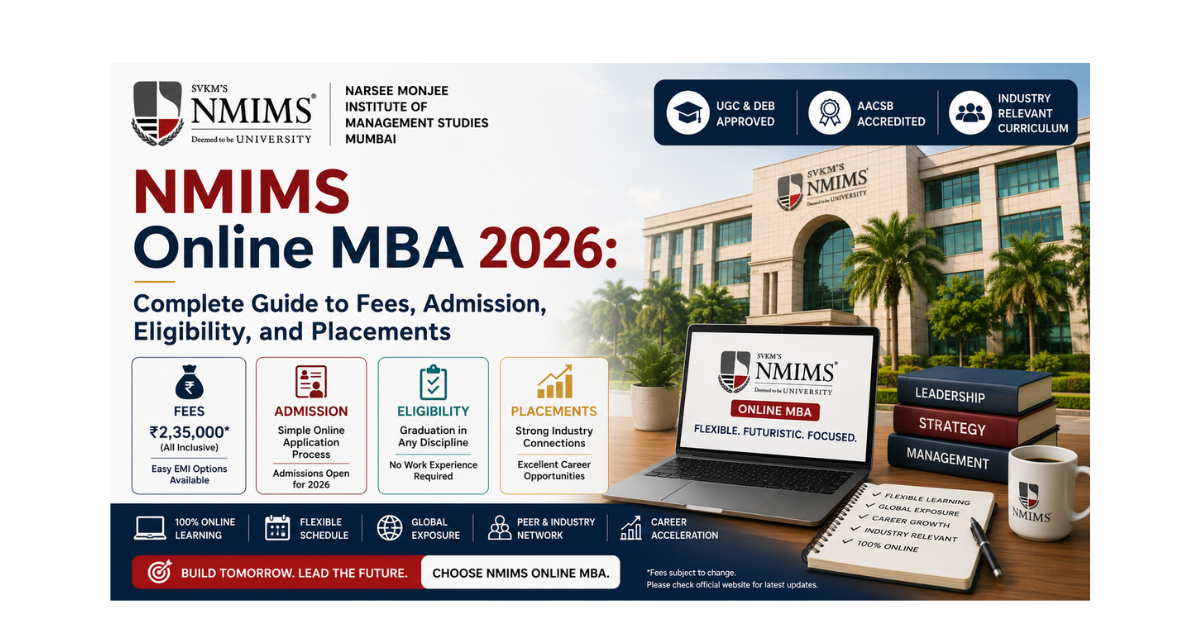
The total program fees for NMIMS Online MBA range from approximately Rs. 1.4 lakh to Rs. 3.8 lakh for the complete two-year program. The variation within that range is driven by three factors: the specialization selected, whether you choose a single or dual specialization, and whether you are enrolled in the standard MBA track or an executive-oriented track.
For the standard two-year Online MBA with a single specialization in core areas such as Marketing Management, Finance Management, HR Management, or Operations Management, the total fee typically falls between Rs. 1.5 lakh and Rs. 2.5 lakh.
Dual specialization programs, which carry a heavier course load, sit at a higher fee point. Executive MBA tracks, designed for senior professionals, carry the highest fees within the online portfolio and can approach or exceed the Rs. 3.5 lakh range.
A critical note on accuracy: fee structures for professional programs are reviewed and updated between intake cycles. The figures cited here reflect publicly available documentation and program data from the 2025-26 cycle. Before finalizing your financial planning or submitting your application for the 2026 intake, verify the exact fee for your specific program and batch directly through the NGA-SCE admissions team. Relying on fee figures from aggregator websites or promotional articles without cross-referencing the official source is one of the more common planning errors candidates make.
For context on relative value, the full-time MBA at NMIMS Mumbai, specifically the MBA Core program, carries a total fee in the range of Rs. 22 to 25 lakh for the two-year residential program. The Online MBA provides access to the NMIMS credential at roughly 8 to 15 percent of that cost. For a working professional who continues earning through the program rather than forgoing two years of income, the real financial comparison is even more favorable.
Payment Flexibility, Scholarships, and Employer Funding
Fees are structured and paid semester-wise across the program duration, which for a two-year, four-semester program means payments at roughly six-month intervals. This structure makes the program significantly more manageable from a cash flow perspective than a single upfront payment would be.
EMI and education loan options are available through banking partners, though the specific partner institutions and applicable interest rates should be confirmed with NGA-SCE at the time of application since these arrangements are subject to change.
Scholarship provisions exist under merit-based, need-based, and specific demographic or professional categories. Candidates with consistently strong academic records or from specific professional backgrounds are advised to inquire about scholarship eligibility during the admissions interaction.
For candidates whose employers maintain a learning and development or tuition reimbursement budget, the NMIMS Online MBA fee structure is low enough that many organizations approve it as a professional development investment. If you intend to pursue this route, checking your company's L&D policy before your application is complete allows you to factor the potential employer contribution into your net cost calculation.
Specializations in NMIMS Online MBA 2026
What Each Specialization Actually Prepares You For
NMIMS Online MBA offers the following specializations. Each description here is written to reflect what the curriculum actually prepares you to do professionally, not just what the subject area sounds like.
Marketing Management builds capability in consumer behavior analysis, brand strategy, marketing research methodology, digital channel management, and performance measurement. It is well-suited for professionals working in sales, brand management, digital marketing, advertising, and business development who want to move from execution to strategic ownership of marketing functions.
Finance Management develops competency in corporate financial analysis, investment appraisal, financial risk management, and capital markets. Professionals in banking, accounting, insurance, fintech, and corporate finance functions who want to deepen technical credibility or move into senior analytical roles find this track most relevant.
Human Resource Management covers workforce planning, talent acquisition strategy, labor law, performance management systems, compensation design, and organizational development. HR professionals aiming at business partner or HR leadership roles, as well as general managers who want to develop stronger people management depth, benefit most from this track.
Operations Management addresses supply chain design, process improvement methodologies, project management, quality management systems, and logistics. Manufacturing, retail, logistics, and consulting professionals who manage delivery and process functions will find this curriculum most directly applicable.
Information Technology Management sits at the intersection of technology and business strategy. It covers IT governance, digital transformation management, enterprise systems, data-driven decision making, and technology project leadership. Tech professionals who want to transition from technical individual contributor roles toward IT leadership or business-technology bridge roles find this track most useful.
Supply Chain Management goes deeper into procurement, logistics network design, inventory optimization, and supplier relationship management than the Operations track does. It is particularly relevant for professionals in FMCG, pharmaceutical, automotive, and retail sectors where supply chain complexity is a primary operational challenge.
Dual Specialization: When It Helps and When It Does Not
NMIMS allows students to combine two specialization areas within the Online MBA program. The option is worth evaluating carefully rather than selecting or dismissing without thinking it through.
Dual specialization adds genuine value in specific career contexts. Finance combined with Data Analytics positions you well for fintech, investment analytics, and management consulting roles where quantitative depth across two domains is a differentiator. Marketing combined with Operations gives e-commerce and consumer goods professionals a cross-functional view that single-discipline peers do not have. HR combined with Finance is increasingly relevant as compensation analytics and workforce financial planning become more sophisticated.
The case against dual specialization is depth. Spreading your coursework across two specializations means covering more ground at the cost of going as deep in either as you would with a focused single track. In technically demanding fields where domain expertise is the primary hiring criterion, a single specialization with depth will often serve you better. If you are transitioning into a field where you need to build credibility from scratch, going narrower and deeper is generally the stronger positioning strategy.
NMIMS Online MBA Placements and Career Outcomes
What Placement Support Looks Like in Practice
Placement outcomes are the area where candidates most often encounter a gap between expectation and reality in online MBA programs, and being clear about this upfront is more useful than reassuring language that creates false expectations.
Full-time residential MBA programs operate structured placement seasons where companies visit campus, conduct batch interviews, and make offers to students who have not yet started working. That model depends on physical proximity, a residential student pool, and institutional relationships built around it.
NMIMS Online MBA placement support operates through a different model because its students are geographically distributed working professionals. What NGA-SCE provides includes career counseling sessions, resume and LinkedIn profile development workshops, mock interview preparation, access to job listings from partner companies, alumni networking events, and virtual career fairs where recruiters interact with the student community.
These services are substantive and can meaningfully accelerate career transitions and promotions for students who engage with them actively. The distinction that matters is this: placement support creates access and preparation, but the initiative to convert that into career outcomes belongs to the individual student. Candidates who attend every career session, proactively reach out through the alumni network, update their positioning continuously through the program, and treat the two years as a career development process rather than a credential collection exercise consistently report better results.
Salary Outcomes: Realistic Ranges Based on Verified Patterns
Career outcome data for online MBA programs is inherently harder to verify than full-time placement statistics. Full-time programs publish median salary figures from a single placement season. Online MBA outcomes play out over one to three years post-graduation and are shaped by the individual's starting salary, industry, city, and career strategy. Aggregated figures can be misleading in either direction.
Based on available outcome data from NGA-SCE program documentation and professional surveys of alumni from comparable cohorts, the salary increase range most commonly cited by graduates falls between 20 and 45 percent within 12 to 24 months of completing the program. That range is wide because the variables driving it are significant. A professional with eight years of experience in a senior individual contributor role using the MBA to move into management at a larger firm will typically see a larger jump than a three-year professional earning a moderate salary who gets promoted internally.
The career outcome pattern where NMIMS Online MBA consistently adds the most measurable value is mid-career professionals with five to ten years of experience who use the program to formally validate domain expertise they already have, to cross into a new function, or to position themselves for a management layer transition they had been unable to access without the credential.
Employer and Recruiter Network
The NMIMS alumni and recruiter network spans a broad range of industries and functions. Companies that have historically engaged with NMIMS for talent include Deloitte, KPMG, Ernst and Young, PricewaterhouseCoopers, HDFC Bank, ICICI Bank, Axis Bank, Infosys, Tata Consultancy Services, Wipro, HCL, Reliance Industries, Marico, Asian Paints, Godrej Consumer Products, Amazon India, Flipkart, and a significant number of mid-market consulting, financial services, and manufacturing firms.
The clarification that candidates should keep in mind: these companies hire from the NMIMS ecosystem broadly, which includes full-time campus graduates, alumni, and online program graduates. The online MBA credential, particularly in combination with relevant work experience, passes resume screening at organizations that recognize the NMIMS name. It does not guarantee an interview at any of these companies, but it removes barriers that a less recognized credential might leave in place.
Curriculum, Faculty, and the Weekly Learning Experience
How the Program Delivers Its Teaching
NMIMS Online MBA is delivered through a Learning Management System that hosts recorded video lectures, course reading materials, assignment portals, peer discussion forums, and live session links. The platform is accessible via desktop browser and mobile applications, which means engagement with course material is not tied to a fixed location or device.
Live virtual sessions are scheduled primarily on weekday evenings and weekend slots to work around standard professional schedules. These sessions are conducted by faculty and are interactive in format, incorporating Q and A exchanges, case discussions, and structured group activities. Attendance is tracked and contributes to your internal assessment component.
The realistic weekly time commitment for staying current with coursework is between 8 and 12 hours. This includes attending or reviewing live sessions, completing readings, submitting assignments, and participating in discussion forums. During project submission periods and before examinations, this figure rises to between 15 and 18 hours per week for most students.
That level of commitment on top of a full-time job and personal responsibilities is manageable, but it is not effortless. Students who underestimate the time requirement in the early semesters and fall behind on coursework find it progressively harder to catch up. Setting a fixed weekly schedule for program work before your first semester begins is one of the most practical things you can do to set yourself up for success.
Applied Learning: Projects, Cases, and Peer Work
Beyond lecture content, the NMIMS Online MBA incorporates applied learning through industry case studies, group projects, and semester-end capstone assignments. The case study material draws heavily from Indian business contexts, which makes it more directly relevant to the environments most students are working in, rather than relying primarily on Western business school cases that may not map well to Indian organizational realities.
Group project work is structured so that teams include students from diverse industries and professional backgrounds. This cross-functional composition is intentional. Working through a supply chain problem with teammates who bring perspectives from finance, marketing, and HR produces solutions and learning that are qualitatively richer than what a homogeneous group would develop.
Faculty delivering the program include NMIMS full-time academics and industry practitioners who bring active professional experience into the classroom. Practitioner faculty are particularly effective in courses covering emerging practice areas such as digital marketing analytics, financial risk management, and supply chain technology, where real-world contexts shift faster than standard textbooks can track.
An Honest Assessment: Strengths and Honest Limitations
Any guide that presents only the positive case for a program should be read with skepticism. Here is an honest assessment of where NMIMS Online MBA stands in 2026.
What the program does well is significant. It carries a brand name that is genuinely recognized by Indian recruiters, unlike programs from institutions that exist primarily as online credential providers. It is regulated under the UGC-DEB framework, which provides legal validity and regulatory accountability. Its fee structure is accessible relative to what comparable credentials cost at full-time institutions. The curriculum is regularly updated and grounded in industry-relevant content. The faculty mix provides both academic rigor and practical context.
Where honest limitations exist is also important to understand before you apply. The online mode is disclosed on your degree certificate, and while progressive employers and most HR departments treat this fairly in 2026, not every hiring context does. Some sectors and some specific organizations still carry preferences for residential degree holders in their senior hiring criteria. This is less common than it was five years ago, but it exists and you should factor it into your research for your specific target roles.
The placement support model is meaningfully different from full-time program placements, and outcomes depend substantially on how actively you engage. Students who treat the program as a passive credential will not see the same results as those who engage fully.
Finally, the learning experience, while well-structured, does not fully replicate what a two-year residential MBA cohort provides in terms of depth of peer relationships, intensity of collaborative work, and the intangible benefits of sustained physical community. If those elements are important to your MBA goals, the online format has inherent constraints that no program design can fully overcome.
Conclusion
The NMIMS Online MBA in 2026 represents a legitimate and meaningfully valuable option for working professionals who want a credible business management credential without pausing their careers. It is backed by a UGC-recognized deemed university with over four decades of institutional history, regulated under the UGC-DEB framework, priced at a level that working professionals can realistically manage, and structured around the schedules and constraints of people who are already employed.
It is not the right choice for every candidate. If your goal is the full residential MBA experience, the NMIMS campus programs or other full-time programs are the correct answer for you. If your goal is a flexible, credible, and practically oriented qualification that you can complete while continuing to grow professionally and financially, the NMIMS Online MBA delivers that with fewer compromises than most alternatives in its category.
Apply early, engage actively, use the career services and alumni network deliberately, and treat the two years as a professional development investment rather than a paperwork exercise. Those habits determine outcomes far more than the institution's name alone ever will.
Frequently Asked Questions
Is the NMIMS Online MBA recognized by the UGC and valid for private and government sector jobs in India?
Yes. NMIMS is a UGC-recognized deemed university under Section 3 of the UGC Act, 1956. The Online MBA is offered under the UGC-DEB framework, which governs all online and distance education programs from recognized universities. The degree is legally valid for employment in both private and government sector roles that accept degrees from recognized Indian universities. The certificate specifies the online mode as required by UGC regulation.
What is the realistic total cost of completing NMIMS Online MBA including all fees?
Total program fees range from approximately Rs. 1.4 lakh to Rs. 3.8 lakh depending on specialization and program track, paid semester-wise over the two-year duration. Additional costs to factor in include the application processing fee, examination fees if applicable, and any study materials or technology costs not covered in the program fee. Always confirm exact figures for your specific program and batch from the official NGA-SCE portal before finalizing your budget.
How much time per week does the NMIMS Online MBA realistically require from a working professional?
The average weekly commitment during regular coursework periods is 8 to 12 hours, covering live sessions, recorded lectures, readings, and assignments. During project submission and examination periods, this rises to 15 to 18 hours per week. Planning your schedule around this commitment before the program begins is more effective than adjusting reactively once you have fallen behind.
Does the NMIMS Online MBA degree certificate specify that the program was completed online?
Yes. As per UGC-DEB regulations governing online and distance programs, the degree certificate reflects the online mode of study. The certificate is fully valid and from a recognized institution. There is no misrepresentation involved. Candidates should understand this clearly before applying and consider how it may be received in their specific target industry and role context.
Which specialization in NMIMS Online MBA gives the strongest career return in 2026?
No single specialization universally outperforms others because career outcomes depend primarily on the individual's prior experience, target industry, geographic market, and how actively they apply the learning and networking during and after the program. That said, Finance Management, Marketing Management, and IT Management have shown consistent post-MBA salary movement in current market conditions, particularly for professionals transitioning into analytics-oriented, client-facing, or business leadership roles in banking, fintech, FMCG, consulting, and technology sectors. Choose based on where your career is going, not based on which specialization sounds most impressive.